- You have no items in your shopping cart
- Continue Shopping

There’s a question that haunts modern life: When will I finally have enough?
We chase promotions, bigger houses, fuller bank accounts — always believing that contentment lives just beyond the next milestone. But what if the life we’re working so hard to achieve is the one we’re sacrificing right now to get there?
An old story from a Brazilian fishing village holds a mirror up to this paradox, and what it reflects might surprise you.
The Meeting by the Shore
Picture a sun-drenched afternoon on the coast of Brazil.
The waves roll gently onto golden sand. A businessman sits on the beach, laptop closed for once, trying to remember what relaxation feels like.
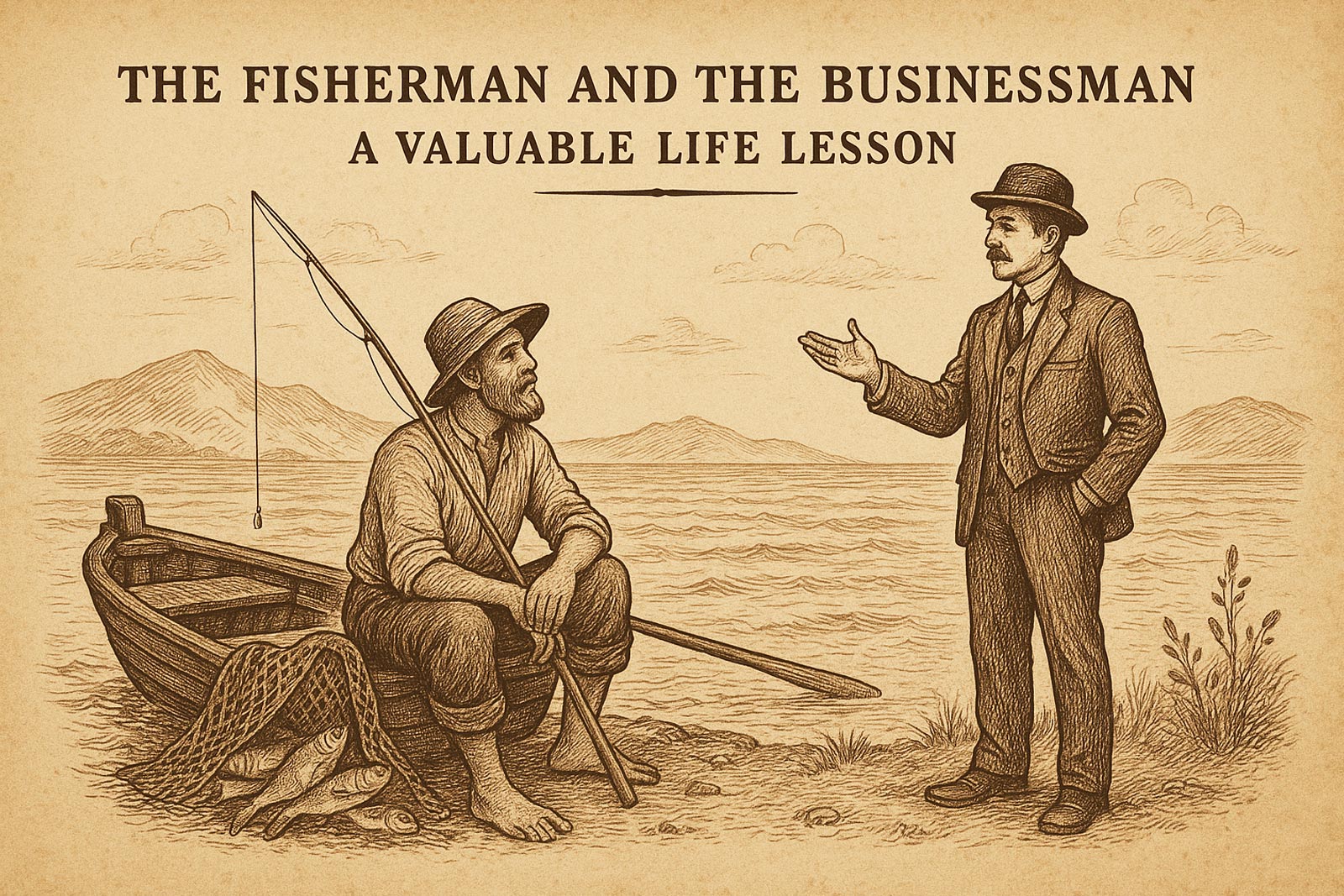
He watches as a small wooden boat glides toward shore, rowed by a local fisherman. The boat sits low in the water, heavy with the day’s catch — several large, beautiful fish glistening in the afternoon sun.
The businessman’s mind immediately goes to work, calculating, analyzing. He approaches the fisherman as he secures his boat.
“Impressive catch,” the businessman says. “How long did it take you to catch all of those?”
The fisherman smiles, wiping his weathered hands on his pants. “Oh, not very long. Just a short while.”
The businessman’s eyes widen. An opportunity. A problem to solve.
“Then why don’t you stay out longer and catch even more?”
The fisherman looks genuinely puzzled by the question. “Why would I do that? This is enough to feed my whole family.”
The Life We Already Have
The businessman’s curiosity grows. If this man finishes work so early, what does he do with the rest of his time? Surely he must be wasting it.
“So what do you do for the rest of the day?”
The fisherman’s face brightens as he describes his life:
“Well, I wake up naturally when the sun rises. I go out to sea and catch a few fish in the cool morning air. Then I return home and play with my children — we build sandcastles, we laugh, we explore. In the afternoon, I take a nap with my wife, feeling her breath beside me. When evening comes, I walk to the village and join my friends. We drink together, play guitar, sing songs, and dance under the stars until we’re tired and happy.”
He pauses, then adds with contentment in his voice, “It’s a good life.”
The Plan for Success
The businessman can barely contain himself.
Here is a man with potential, completely unaware of what he could become. Here is raw material waiting to be optimized, scaled, maximized.
“Listen,” the businessman says, leaning forward with the intensity of someone about to change a life. “I have a PhD in business management from a top university. I can help you become truly successful. Let me show you how.”
The fisherman listens politely as the businessman unveils his vision:
“Starting tomorrow, you need to spend more time at sea. Catch as many fish as possible, work longer hours. Save that money. When you have enough, buy a bigger boat. Catch even more fish. Scale up.”
The businessman’s voice rises with excitement as the plan unfolds:
“Soon you’ll afford multiple boats. Hire other fishermen to work for them. Then you’ll need to cut out the middlemen — start your own processing plant for canned fish. Build a distribution network. Control the entire supply chain.”
He’s pacing now, hands gesturing, painting a picture of empire.
“Eventually, you’ll move from this small village to São Paulo. Set up a proper headquarters. Manage your growing operations. Expand to other regions. Maybe even internationally.”
The fisherman listens quietly, his expression unreadable.
“And after that?” he asks simply.
The Promised Land
The businessman laughs — the kind of laugh that says the best part is coming.
“After that? After that, my friend, you go public. Float your shares on the stock exchange. You’ll be worth millions. You can live like a king!”
The fisherman tilts his head. “And after that?”
The businessman’s smile grows even wider. He’s reaching the pinnacle now, the ultimate reward that makes all the sacrifice worthwhile.
“After that, you can finally retire! You’ll have earned it. You can move to a small house by a fishing village — somewhere peaceful, beautiful. You can wake up naturally in the morning, go out and catch a few fish just for the joy of it. Return home to play with your grandchildren. Take afternoon naps. In the evenings, meet with friends, have drinks, play music, sing and dance until late into the night.”
He spreads his arms wide, presenting this vision like a gift.
“You’ll be able to do whatever you want!”

The Question That Changes Everything
The fisherman is quiet for a long moment.
The waves continue their eternal rhythm. Seabirds call overhead. The sun begins its slow descent toward the horizon.
Finally, the fisherman speaks, his voice gentle but clear:
“But isn’t that what I’m doing now?”
The businessman opens his mouth. Closes it. Opens it again.
He has no response.
The Wisdom We Keep Missing
This story, told in variations across cultures for generations, touches something profound in our modern souls.
We are the businessman, aren’t we? Most of us, anyway.
We’ve been taught that life is a ladder we must climb, a game we must win, a gap between current reality and future happiness that must be closed through achievement, acquisition, and advancement.
We tell ourselves: “Once I get the promotion, then I’ll relax.” “Once I pay off the mortgage, then I’ll enjoy life.” “Once the kids are grown, then I’ll pursue my passions.” “Once I retire, then I’ll finally live.”
But the fisherman is already living.
Not waiting to live. Not preparing to live. Not earning the right to live.
Living. Now. Today.
What the Fisherman Understands
The fisherman in this story embodies a form of wealth that has nothing to do with bank accounts.
He understands what the businessman has forgotten:
Time with loved ones cannot be purchased later — it only exists in the present moment. Those hours playing with his children aren’t “wasted” because they’re not productive. They’re the entire point.
Enough is enough. He’s solved the problem of scarcity not by acquiring more, but by reducing his needs to match his resources. This isn’t poverty — it’s freedom.
Joy doesn’t require justification. The singing, dancing, and guitar playing aren’t rewards for hard work. They’re not earned through suffering. They simply are — expressions of human aliveness that need no external validation.
Presence is the ultimate success metric. The fisherman is awake to his own life. He experiences it rather than postponing it.
What the Businessman Has Forgotten
The businessman isn’t wrong about business. His plan would probably work. The fisherman could become rich by conventional measures.
But somewhere along the way, the businessman lost the thread.
He forgot that wealth is supposed to serve life, not replace it.
He forgot that the point of security is to enable presence, not to postpone it indefinitely.
He forgot that success, stripped of its cultural mythology, is simply the ability to live in alignment with what matters most to you.
Most tragically, he forgot that retirement — that promised land of “finally living” — is just his current life given permission to exist.
The Modern Dilemma
Here’s where this story becomes complicated for us.
Because we can’t all be fishermen. The modern world requires participation in systems larger than village life. We have mortgages, healthcare costs, children’s education to fund, aging parents to support.
The story isn’t telling us to quit our jobs and move to a beach.
But it is asking us a crucial question: What if you’re already destroying what you’re working so hard to achieve?
Consider:
You work 60-hour weeks to provide for your family, but miss your children’s childhood in the process. By the time you’ve “succeeded,” they’re grown and gone.
You sacrifice your health for career advancement, planning to focus on wellness “later.” But later, you’re managing chronic conditions that could have been prevented.
You postpone that trip, that hobby, that creative project, that meaningful conversation until retirement. But how many people do you know who reached retirement only to find they’d forgotten how to play?
The businessman’s plan isn’t wrong because ambition is bad. It’s flawed because it treats the present as a problem to be solved rather than a life to be lived.
Finding Your Version of Enough
The deepest teaching here isn’t about choosing between ambition and contentment. It’s about knowing what you’re actually working toward.
Ask yourself:
What does “enough” look like for you? Not what society says. Not what your parents expect. Not what your neighbors have. What would actually be enough for your life to feel complete and worthwhile?
What are you postponing? Which experiences, relationships, or joys are you delaying until “someday”? What if someday never comes?
What would you do if you “made it”? Really imagine it. You’ve achieved every goal, accumulated every success marker. Now what? Are you doing any of those things now? If not, why not?
What are you trading for success? Every yes to one thing is a no to another. What are you saying no to right now? Is it worth it?
The Practice of Present Wealth
Living like the fisherman in a modern context requires intention. Here are practices that can help:
Define your enough point. Get specific. What income would actually meet your needs and wants? What size home? What lifestyle? Most of us are working toward an undefined “more” that can never satisfy.
Build rituals of presence. The fisherman has clear rhythms — morning fishing, afternoon naps, evening music. What are your equivalent rituals? When do you fully inhabit your life rather than just manage it?
Question busy-ness. Every time you say “I’m too busy,” ask: “Too busy for what?” If you’re too busy for the things that matter most, your busy-ness is a problem, not a badge of honor.
Practice strategic underachievement. Yes, you could work harder, do more, optimize further. But to what end? Sometimes the most radical act is to stop climbing and notice where you already are.
Invest in irreversible time. Time with young children, aging parents, dear friends — these windows close. They cannot be recovered later, no matter how much money you have.
The Courage to Stop Climbing
Perhaps the most challenging aspect of this story is that it requires us to get off the ladder while everyone else is still climbing.
Our entire culture is the businessman — constantly selling us the idea that fulfillment lives in the next achievement, the next acquisition, the next level.
To live like the fisherman is to commit an act of cultural rebellion.
It means you might not be the richest person in your friend group. You might not have the biggest house on the block. You might not reach the corner office or build an empire.
But you’ll have your mornings. Your afternoons. Your evenings. Your presence with the people you love. Your capacity to play guitar, to dance, to laugh under the stars.
You’ll have your life, not as a reward for decades of sacrifice, but as a daily experience.
The Question Only You Can Answer
The story ends with the fisherman’s question hanging in the air: “Isn’t that what I’m doing now?”
But the story doesn’t end for us. We carry that question into our own lives.
Are you working toward something you’re simultaneously destroying? Are you postponing the life you could be living right now? Are you climbing a ladder only to discover it’s leaning against the wrong wall?
Or perhaps you’re the businessman in this story, and you’ve just been reminded of something you once knew but forgot: that wealth isn’t just what we have, but what we don’t need. That success isn’t just what we achieve, but what we’re present for. That a good life isn’t something we arrive at in the future — it’s something we practice now.
The fisherman isn’t naive. He’s awake.
The question is: Are you?
Start Your Transformation: Get Our Free 7-Day Gratitude Challenge
Discover the practices, journal prompts, and daily affirmations that lead to unshakeable inner peace — all in just one week.
Join 1,000+ others transforming their mindset today.

